
Beyond the Brigade
What cooking with friends taught me about how kitchens should really work.

My second-to-last practical ever at Le Cordon Bleu involved making sausages the old-fashioned way. A drum sieve, a piping bag, and a dream created some of the best boudin I’ve ever tasted. While I’m feeling abundantly eager to close this chapter, I caught myself getting emotional while guiding a sausage casing as Karl piped in the filling and Meghan filmed the hilarity.
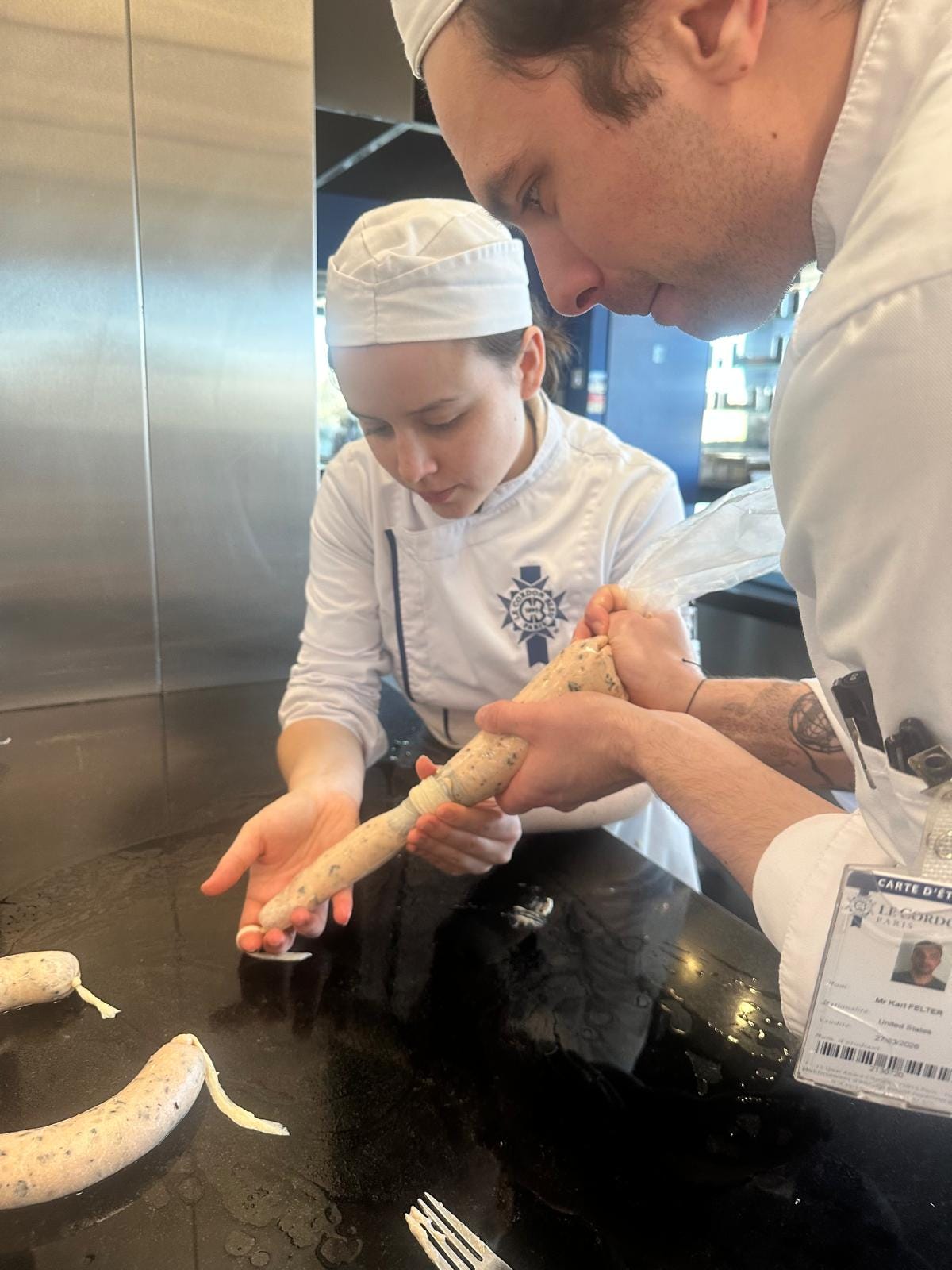
It’s clear that my sentimentality is a result of friendship rather than academics. And this is a kind of friendship that I haven’t experienced in a while - a friendship rooted in craft. My time in the kitchen thus far has been largely a solo endeavor, which is odd for me. Before cooking became my medium, I was a performing artist. Theater thrives on collaboration. So those days when we got to cook together, I would find myself replenished by the teamwork.
This is a specific kind of teamwork that I’m talking about. It goes beyond just working alongside each other. It’s more than boiling our potatoes in the same pot to save water or sharing chopped herbs because one of us forgot the garnish. It’s tasting a sauce together to figure out how to adjust its seasoning or texture. It’s asking each other how they managed to get the spine out of the rabbit. It’s taking turns filling the sausage casing so that everyone gets to experience each strange step of the process. It’s a community in pursuit of improvement.
I’ve been in a period of reflection lately - trying to justify these past six months. Why did I come to this school? What did I gain? What will I take away? Those thoughts have largely revolved around the behaviors of our chefs and the technical skills we either learned or didn’t. But while munching on our little sausage sandwiches (Meghan, Karl, and my first collaboration with our friend Robert over in boulangerie), I began thinking about something else: what actually makes a kitchen work.
So if we ever end up opening a restaurant - which we jokingly refer to as LMK - here’s what I believe the kitchen should be set up.
Le Cordon Bleu is a traditional culinary school. Not only are the recipes rooted in history, but so is the way professional kitchens are discussed. References to chef de cuisine and commis litter our demonstrations - typically with the chef making some wise joke about how we’re about to face the bottom of the kitchen food chain. This culinary jargon is a product of Auguste Escoffier’s brigade de cuisine.
Created in the late nineteenth century, the brigade (derived from military structures) divides labor into highly specialized stations. It enabled kitchens to produce complex menus efficiently while maintaining high standards of consistency and quality. It established a clear chain of command, with the Chef de Cuisine at the top, supported by the Sous-Chef, specialized Chefs de Partie, and many Commis or line cooks. Labor was divided among stations such as sauces, fish, roast, and garde manger. This system dominated kitchen structures for most of the twentieth century.
It’s important to consider the context in which Escoffier devised this system. He was working with the world of grand hotel dining - kitchens that prioritized precision, repetition, and large-scale service. The specialization built into the brigade allowed cooks to master a very specific set of movements, which ultimately led to efficiency. Escoffier’s kitchen was also a world without modern machinery, where manual dexterity was the primary driver of success. If a cook spent ten years on the Poisonnier station, their ability to fillet a Dover sole was unparalleled. Repetition was essential.
But now it’s the twenty-first century, and like most industries, the restaurant world has changed. Technology, rising labor costs, and a growing concern for morale and individuality are all pushing kitchens to reconsider how they operate. In my opinion, these are some of the greatest problems with the traditional brigade system:
Limited Learning Opportunities: In a traditional brigade, repetition is the point. A cook might spend an entire service turning artichokes, passing potatoes through a tamis, or mounting sauces, repeating the same motion until it becomes automatic. While this produces consistency, it can also narrow a young cook’s understanding of the dish as a whole—reducing cooking to a series of isolated gestures rather than a fully integrated act of creation.
Reinforces Toxic Power Dynamics: Escoffier modeled the brigade after military structures, and that hierarchy still shapes the culture of many kitchens today. Authority flows downward, with chefs commanding stations in a system where questioning or experimentation from junior cooks is rarely encouraged. While hierarchy can create order during service, it can also reinforce the harsher aspects of kitchen culture—where intimidation replaces mentorship, and silence becomes a survival strategy.
Station Silos: When kitchens are divided into strict stations, each cook becomes responsible for only one fragment of the meal. The fish cook sees the fillet but not the stock, the garnish cook prepares vegetables without seeing the protein, and the sauce station finishes the dish without ever touching the raw ingredient. This fragmentation can create bottlenecks during service and a kind of tunnel vision in prep. Ingredients get trimmed, passed along, and sometimes discarded before anyone has the chance to think about their full potential.
Economically Outdated: The brigade system was designed for the grand hotel kitchens of the late nineteenth century—places like the Savoy and the Ritz, where large staffs could be assigned to highly specific roles. Most modern restaurants operate under entirely different conditions. Teams are smaller, menus change constantly, and labor is one of the highest costs a restaurant carries. Maintaining a strict brigade under those circumstances is often impractical.
So what do we do about it?
Rather than abandoning the brigade entirely, many kitchens have begun adapting it—blurring the boundaries between stations and redistributing responsibility across smaller teams. What has emerged is something closer to a hybrid or pod-based kitchen structure.
The concept of pods comes from industries like software development, design studies, and healthcare, where small cross-functional teams are responsible for completing a project from start to finish. Pods work because they restore something that large hierarchies often lose: the feeling that a small group of people is responsible for making something together. They also encourage problem-solving by exposing each member of the team to multiple stages of the process and their effects.
In kitchens, pods typically consist of two to five cooks responsible for a group of dishes or a section of the menu rather than a single station. Cooks move between tasks- sauce work, proteins, vegetables, plating - allowing the team to adapt as service demands change. There’s a fluidity and dynamism to this structure that supports both efficiency and morale.
Personally, I find the idea exciting. As a cook, it means seeing an ingredient from start to finish. You cooks develop a deeper understanding of technique, flavor balance, and plating much more quickly. It reflects a more modern idea of the cook - not as a cog in a machine, but as a creative participant in the dish.
If the brigade system imagined the kitchen as an army, the pod model imagines it as a small ensemble—cooks moving together through the rhythm of service rather than standing guard at their assigned stations.
And once you start looking for it, you begin to notice traces of this structure in many contemporary kitchens.
At Chef’s Table at Brooklyn Fare, despite the appearance of tradition - the tall hats, the quiet intensity - service looks less like a row of isolated stations and more like choreography. Plates rarely emerge from a single cook. Instead, several chefs lean over one dish, placing garnishes, finishing sauces, adjusting every last detail just before it leaves the counter. Because the kitchen is open to the dining room, guests witness the plate as a moment of collective attention.
At restaurants where the menu is driven by hyper-seasonal and local ingredients, this kind of collaboration becomes even more necessary. At One White Street, where the kitchen works closely with produce from its own farm, the menu shifts constantly depending on what is harvested that week. When cooking is guided by seasonality, specialization becomes harder to maintain. The cooks have to respond to the ingredient itself, moving fluidly between techniques and tasks as dishes evolve.
The clearest version of this I’ve seen was while staging at King. The menu changes daily depending on what ingredients arrive that morning, and the kitchen moves with a calm flexibility that reflects that reality. All of the cooks work closely together, tasting and adjusting dishes as they take shape. It felt less like a production line and more like a small group of people solving a shared problem: how to make the ingredient in front of them shine.
Now that I’m at the end of my time in culinary school, all of these experiences and observations are starting to click for me. On the days when we cooked alone, the kitchen often felt tense and segmented. Even though we handled every component of the final dish - something that never happens in real kitchens - there was still a strange sense of detachment.
But when we worked together, everything felt better. People laughed. Plates came together more naturally. And the best part - the food somehow tasted better.
And thinking back on the last six months at Le Cordon Bleu, that’s what I’ll miss most—hands down. Not the recipes or the techniques, but the feeling of a group of cooks moving through service together, sharing the work of turning ingredients into something worth serving.
I’m not exactly sure what waits for me back in New York, but I do know this: whatever comes next will be built around the same thing that made these kitchens feel alive—people cooking together.
Until the next course,
Lily
LMRK 😜🙃☺️
Well written, tied it all back to friendship ✨👏